
AI In Software Testing: Everything You Need to Know

Software development is changing quickly, and so is the method we use to test programmes. Conventional testing techniques often fall short in accuracy, scalability and speed. According to the Capgemini World Quality Report 2022-23, 63% of organisations believe that AI will significantly transform their software testing processes within the next two years, underscoring the increasing need for smart, automated solutions.

In software testing, artificial intelligence (AI) combines machine learning with automation to expedite the QA process. This blog discusses software testing and AI, their importance, and how to use AI in software testing to improve accuracy, speed, and efficiency.
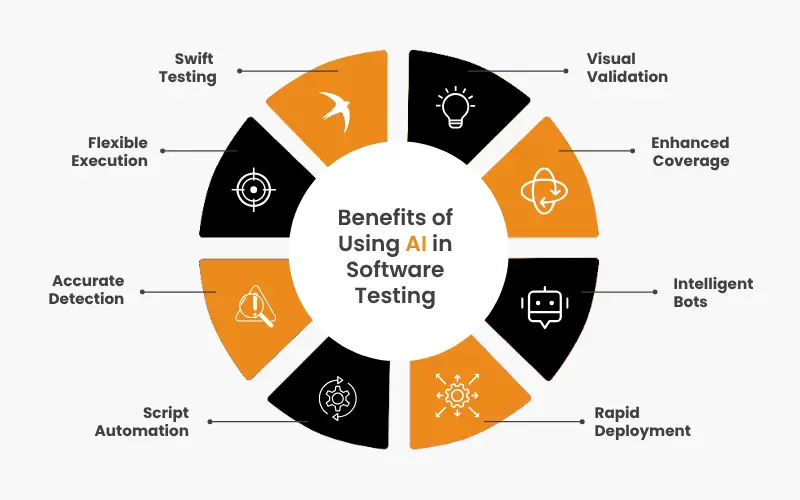

What is AI in Software Testing?

In software testing, AI as well as machine learning techniques are utilized to automate and improve the testing process. This is similar to human testing, but much quicker and more effective. It involves using intelligent algorithms that can learn from historical data, adapt to changes in code, and draw knowledgeable conclusions.

These artificial intelligence-powered products can handle a variety of tasks, including:

  • Automatically generating test cases.
  • Identifying high-risk areas in the application.
  • Detecting anomalies.
  • Prioritising test efforts based on historical bug patterns.

Understanding how artificial intelligence may be used in software testing starts with recognising areas where conventional testing is insufficient. Offering scalability, flexibility, and intelligent decision-making, artificial intelligence closes these gaps.

AI technologies can rapidly learn from data and make testing smart, not just quicker, whether it be UI validation or regression testing. AI becomes essential for high-quality releases at speed as the software industry welcomes DevOps and continuous delivery.

FeatureManual TestingAI Testing
SpeedSlow; dependent on human pace and availabilityFast; executes tests in parallel with minimal human input
AccuracyProne to human errors and oversightHigh accuracy with reduced false positives/negatives
Test CoverageLimited to predefined cases and resources Broad coverage through dynamic, data-driven test generation
CostHigh long-term cost due to repeated manual effortCost-effective with reduced labor and faster releases
MaintenanceRequires ongoing updates and manual test case revisionsSelf-healing scripts reduce maintenance even after UI/logic changes
ScalabilityNot scalable beyond a certain team size or budgetEasily scalable across multiple environments and apps
Test CreationTime-consuming and requires in-depth knowledge of system behaviorFaster with natural language input and intelligent pattern recognition
AdaptabilityLow; changes require manual test reworkHigh; adapts to code/UI changes using machine learning models
When to UseExploratory, Usability/UI Testing, Ad-hoc, Small-scale, Early design validationRegression, Automation, Large-scale, Performance, Security, Predictive analytics

Why use AI in Software Testing?

There are many strong reasons why using AI in software testing is no longer a choice but a must. Traditional testing methods cannot keep up with the complexity of apps and the shortening of development processes. Businesses can be more efficient, accurate, and quick by using software tests and artificial intelligence.

AI in software testing

1. Improved Accuracy and Coverage

Human mistakes are natural in manual testing. Testers can overlook edge cases, skip redundant tests, or miss subtle issues due to fatigue or time constraints. AI eliminates these problems by analysing vast datasets—including historical defects, user behaviour and test results—to automatically identify high-risk areas.

It may generate a wide range of test situations with less human involvement but more test coverage. This implies that more comprehensive application testing helps lower the possibility of flaws finding their way to manufacturing.

2. Reduced Human Effort and Errors

Automating time- and effort-saving repetitive chores like performance analysis, UI validation, and regression testing prevents AI technologies from running tests based on code changes, adjusting themselves, and acting without human direction. This guarantees fewer mistakes brought on by consistency or oversight, in addition to lessening manual effort. Teams may thus concentrate on more strategic tasks such as user experience analysis and exploratory testing.

3. Continuous Testing in CI/CD Pipelines

Modern approaches to deploying software in which code changes are done fast and frequently include Continuous Integration/Continuous Deployment (CI/CD). To support this, constant testing must be reliable. AI is very important in software testing because it runs tests automatically as new code is added.

AI systems can examine test effects, identify important cases, and give writers immediate input. This smooth merging ensures quality without slowing things down, making large-scale continuous testing possible.

4. Faster Release Cycles and Time-to-Market

One of the finest features of AI-driven testing is its capacity to accelerate release procedures. By automating time-consuming chores like developing test scripts, executing them, and evaluating the outcomes, teams may drastically decrease test time. This allows businesses to provide fresh features and upgrades faster, more rapidly adjust to market changes, and stay ahead of the competition.

Simply, when QA adopts software testing and artificial intelligence, it transforms from being a bottleneck into a strategic partner. The most crucial issue is not whether or not to use artificial intelligence; rather, it is how to employ it in software testing so that it can perform as intended.

How AI is Revolutionising Software Testing

AI being used in software testing is not just a trend; it is a huge change in how quality assurance is done throughout the whole software development process. Traditional testing methods cannot keep up with how quickly apps are being released and how complicated they are getting. Artificial intelligence changes the game in this way.

AI improves every step of the testing process, from automation to data. Here are some ways that AI can be used in software testing to make it faster, more accurate, and more efficient.

1. Increased Test Automation

In traditional test automation, scripts and set lines are used frequently. However, when the UI changes or new functions are added, these tools often fail to function. AI improves automation by creating test scripts on the fly, studying how applications work, and responding instantly to changes in the code.

Machine learning algorithms can determine the most important test routes based on past data, user behaviour, and failure trends. This allows for more intelligent test coverage, which saves time and resources. AI-driven automation, on the other hand, is always changing, making testing faster and more reliable.

2. Predictive Analytics

One of the most useful things that software testing and AI can do is predictive analytics. AI can find trends and predict where bugs are most likely to occur by analysing a huge amount of old data, such as test runs, defect logs, and code changes.

Instead of depending on gut feelings or guesses, this lets test teams put their efforts where they mean most. For example, AI might guess that a recently changed section is likely to cause bug problems, which would lead to more testing in that area. Predictive analytics also helps with risk-based testing, which puts the tests that give the best business value at the top of the list.

3. Self-Healing Test Scripts

One of the major challenges with traditional automation frameworks is script maintenance. UI changes—like a modified button ID or a renamed field—often break scripts, requiring time-consuming updates. AI introduces self-healing capabilities, where the system automatically detects UI changes and adjusts the test scripts accordingly.

For example, if a button’s ID changes from submit_btn to submit_button, the AI will notice, and the test will still run without any problems. This cuts down on downtime and repair costs, making automation more predictable in DevOps and rapid settings.

4. Natural Language Processing (NLP)

How can AI be used in software testing so that people who are not proficient in technology can understand it better? Natural Language Processing (NLP) shows the way to find the answer. NLP lets business analysts and testers write test cases in simple English. The AI then turns these into scripts that can be run.

The technical and non-technical team members can now work together better, and it will be easier for everyone to learn how to use the testing tools. An automatic test case could be something like, “Check to see if the login button is visible after entering the correct credentials.” Behaviour-driven development (BDD) and acceptance testing are two areas where NLP is beneficial.

5. Visual and Cognitive Testing

In traditional test automation, the way a user interface looks is often not taken into account. Visual testing tools that are driven by AI, on the other hand, use computer vision to check how consistent the user interface is across devices, platforms and screen sizes. They can find visible bugs like buttons that aren’t lined up right, parts that overlap or font styles that aren’t right.

Cognitive testing, on the other hand, mimics human reasoning. It evaluates aspects such as design aesthetics, content placement and colour contrast. These capabilities ensure not only functional correctness but also a high-quality user experience—something conventional tests rarely address.

6. Continuous Testing in CI/CD

In today’s CI/CD pipelines, speed is essential. Every time code is pushed, tests must run immediately and provide actionable feedback. AI enables continuous testing by automatically identifying the part of the application affected due to change in code and selecting only the relevant tests to run.

This smart test selection drastically reduces test cycle times while maintaining high test coverage. AI also integrates seamlessly into DevOps toolchains, ensuring that testing becomes an embedded, real-time process rather than a post-development bottleneck.

7. Enhanced Bug Detection

Usually, bugs are found by following set rules or by inspecting the code by hand. AI then improves this by learning from bugs and usage trends to spot things that do not appear right. Machine learning models can spot possible bugs if they see strange behaviour, slowdowns in speed, or changes in how users interact with the system.

These systems can find things that regular tools cannot, like memory leaks or problems with the user interface’s response. By using AI in software testing, teams can find problems earlier in the cycle, lowering the costs and risks of fixing bugs at the end of the cycle.

8. Test Data Management

To do quality tests, you need quality data. AI creates fake datasets that look like real-world usage without compromising privacy, which helps handle test data. It can also find gaps in the data, anonymise private information, and ensure that rules like GDPR are followed.

AI-driven test data management ensures that every test runs in the best possible settings, increasing accuracy and reliability. This is especially helpful for fields like healthcare and banking, where keeping data safe and secure is very important.

In all of these ways, AI in software testing improves things. It does not replace testers, but it gives them more tools to get more done. It makes testing more consistent, faster, and smarter, which helps teams create high-quality software faster. Learning how to use AI effectively in software testing is now a must for all businesses that want to do well in the digital age, not just QA teams.

Conclusion

Companies are changing how they do quality assurance as they use AI in software testing. AI makes testing more accurate, faster and more efficient by handling jobs that are done over and over, predicting what might go wrong and letting test managers be better. Using AI and software testing together is important for staying ahead of the competition as more businesses adopt lean and DevOps methods.

Learning how to use AI in software testing is important, whether you are just starting or want to grow. It will help you make reliable, high-quality software faster than ever.

©2026 GoWide. All rights reserved.