
The Future of E-commerce: How Digital Transformation is Shaping the Industry

As technology evolves rapidly, shopping experiences are also changing quickly. Companies that once relied on traditional online stores must adapt to stay competitive with new tools, evolving customer needs, and strategic innovations. This significant shift is part of a broader trend in ecommerce digital transformation​, which is redefining how businesses operate and how consumers engage online. It is fundamentally transforming the way future online buying and selling of products is done.

If you don’t know what this means for your company? We have got you covered! We will discuss how the digital transformation of e-commerce is helping to move the business forward and what you need to do to stay ahead.

What Is Digital Transformation in E-Commerce

eCommerce digital transformation​​ refers to the implementation of digital technology across every aspect of the online retail experience, which in turn impacts business operations and the value delivered to consumers. This change enables e-commerce companies to simplify processes, utilise data for more informed decisions, and deliver more personalised and multi-channel experiences.

In addition to online product sales, digital commerce transformation involves rethinking company structures, enhancing consumer engagement, and applying innovation to stay ahead in a fast-paced digital economy. Digital transformation e-commerce strategies are essential for profitability and timeliness, as customers become more proficient in technology and their requirements evolve in line with market trends.

The role of Digital Transformation in transforming the e-commerce industry

Adapting to Changing Consumer Expectations

Customers always want quick and easy purchasing experiences that are also personalised. By utilising modern technologies such as AI-powered product suggestions, chatbots for rapid service, and customised marketing campaigns, digital transformation in e-commerce enables stores to meet these expectations.

Companies currently examine consumer behavior in real time to customise products and predict demand. This results in customer satisfaction, making them more loyal to the brand and increasing their likelihood of staying with the brand for an extended period.

The Importance of Data-Driven Decision Making

Data determines digital commerce change. Every click, transaction, and engagement provides valuable information that companies can use to refine their strategies. Predictive analytics enables businesses to project trends, optimise inventories, and determine more effective prices.

Big data enables e-commerce companies to continually adapt and respond effectively to consumer needs, thereby enhancing business performance and customer experience.

Automation to Boost Efficiency

Automation is transforming retail activities. From processing orders and automating inventory control to handling customer care inquiries with automated chatbots, automation reduces operating costs, streamlines operations, and minimises human error. Robotic process automation (RPA) and machine learning techniques enable the effective handling of recurring activities, allowing teams to focus on strategic business development.

Omnichannel Shopping Experience for the Customers

Consumers can engage with companies through various channels, including mobile applications, the internet, physical stores, and social media. Digital transformation enables the creation of a seamless and uniform omnichannel experience. With coordinated shopping carts and consistent user accounts, consumers can view items on one device and finalise transactions on another. This seamless integration ensures that the brand experience remains consistent and valuable regardless of the point of interaction.

Ensuring Scalability and Security

Scalability and cybersecurity are more crucial than ever, given the increasing volume of traffic, transactions, and data exchange. In e-commerce, digital transformation enables cloud-based technology, allowing businesses to efficiently process complex data.

Strong security measures, including end-to-end encryption, multi-factor authentication, and adherence to data privacy rules, help maintain consumer data privacy and increase trust, a major factor in consumers’ online purchasing decisions.

Increased revenue

By enhancing customer experience, streamlining processes, and enabling more effective marketing, digital transformation in e-commerce can lead to immediate revenue growth. Technologies that increase average order values and sales rates include artificial intelligence-driven ideas, automated workflows, and customised material.

Real-time data enables companies to focus campaigns, adjust prices, and optimise inventories to drive increased sales. Digital technologies also enable companies to enter new industries and expand more effectively easily.

Top 10 e-commerce Digital Transformation trends

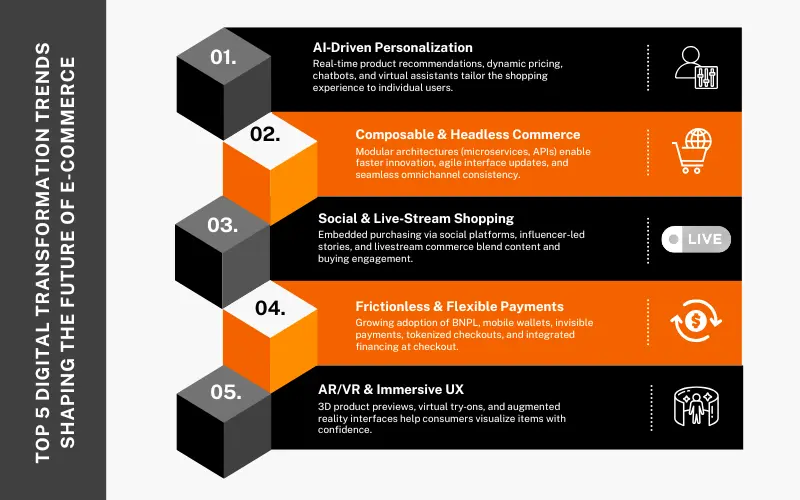
Top 5 e-commerce Digital Transformation trends

The future of online buying is expected to be heavily influenced by many primary trends. These e-commerce trends of digital transformation are changing the way companies interact with customers and operate in the digital marketplace.

1. Improved Customer Experience by Personalisation

Personalisation is expected, as it is no longer a luxury. Utilising artificial intelligence and machine learning can enable e-commerce sites to deliver personalised email campaigns, content, and product recommendations tailored to specific customer preferences.

Using real-time data to modify product offers, pricing, and promotions constantly helps improve the customer journey and increase conversion rates. Hyper—personalisation is expected to generate deeper engagement in 2025.

2. Cutting Costs with Smarter Technology

The transformation of digital commerce is mostly driven by cost efficiency. E-commerce companies are significantly reducing their running costs through automation, artificial intelligence, and cloud computing. While automated customer service systems reduce dependence on human agents, smart inventory systems can avoid overstocking or understocking. These technologies not only save money but also simplify processes, allowing resources to be used where they are most effective.

3. Voice Shopping is Expanding

Increasingly, individuals are utilizing smart speakers, including Alexa, Siri, and Google Assistant, to make online purchases. Customers are asking their gadgets to locate goods, compare prices, and even place orders, rather than typing. This trend is rapidly expanding and is likely to become heavily visible in online shopping by 2025.

Ensuring their items are easily discovered using voice searches is crucial for e-commerce companies. This implies keeping the purchasing experience as brief and straightforward as possible, using simple and casual language.

4. Direct Social Media Shopping

Currently, social media is more than just a platform to use; it is also an opportunity for actual purchases. Users of sites such as Facebook, Instagram, and TikHub may now buy without ever leaving the app. Live shopping videos, influencer recommendations, and simple checkout buttons are making it easier to find and purchase items. Brands that provide quick and entertaining social media purchasing experiences in 2025 will be those that attract more consumers and increase their revenues.

5. Focus on Mobile Optimisation

Mobile optimisation is essential as more than half of e-commerce traffic originates from mobile devices. Mobile-first design is poised to take center stage in 2025. The mobile shopping experience will be improved by elements such as app-based reward programs, voice search, and mobile payment integration. Rising steadily, Progressive Web Apps (PWAs) will provide the same features as a native app without requiring a download, which results in enhancing accessibility and performance.

6. The Rise of the Metaverse

For e-commerce, the metaverse is creating fresh digital boundaries. Online stores, digital showrooms, and 3D product experiences are experiencing increasing popularity. To deliver exceptional shopping experiences to consumers in 2025, e-commerce companies will leverage both augmented reality (AR) and virtual reality (VR). Consumers can virtually try on clothing, view furniture in their homes, or participate in virtual launch events—all from the comfort of their own devices.

7. AI and Machine Learning Redefine E-commerce

Digital transformation e-commerce relies mostly on artificial intelligence and machine learning. These technologies run everything from flexible pricing schemes to smart search engines. AI will enable stores to quickly identify patterns, instantly modify marketing efforts, and build flexible websites that fit every user’s behavior. As artificial intelligence continues to develop, its importance in supply chain forecasting, fraud avoidance, and consumer retention will only increase.

8. Security and Trust Are More Important Than Ever

Cyber risks grow along with e-commerce. Businesses have to give security top attention during their digital transformation in 2025. The standard will include blockchain technologies, biometric authentication, and AI-driven threat detection systems.

Gaining client confidence also depends much on transparency about data use and ethical behavior. Therefore, security becomes the foundation of brand reputation and loyalty.

9. Sustainable Practices Through Technology

Sustainability is a responsibility, not only a latest trend. From streamlining supply chains to reducing packaging waste, digital transformation enables e-commerce businesses to adopt environmentally responsible behaviors.

Specific demand may be predicted by artificial intelligence, therefore preventing overproduction. While electronic bills and minimal packaging reduce environmental impact, smart logistics solutions cut fuel consumption. Brands that match technology with sustainability are going to relate more powerfully to trustworthy consumers in 2025.

10. Continuous Testing and Optimisation

Businesses that want to stay competitive must cultivate an environment that continually improves. Essential tools for improving e-commerce strategies are A/B testing, real-time analytics, and consumer feedback loops.

Focusing on agile techniques and continuous improvement, digital commerce transformation enables businesses to rapidly adjust to market changes, test new products, and optimise user experiences based on real data.

Adapting to the future

Adopting ecommerce digital transformation​ is no longer optional as e-commerce continues to develop; it is now more necessary. Companies that remain adaptable, prioritize customer experience, and invest in leading technologies will be better equipped to succeed in an environment that is constantly transforming.

From personalisation and security to automation and artificial intelligence, the future of ecommerce digital transformation​ is full of opportunities.

Maintaining client expectations, scaling efficiently, and competitiveness by ensuring constant strategy optimisation and knowledge of new trends will help companies to fulfill digital commerce transformation, which is a continuing path towards innovation, durability, and long-term success in the digital age, which is not a one-time project.

©2026 GoWide. All rights reserved.